An intense, fun action adventure title hand-made to bring out the best Virtual Reality has to offer, based on a classic AAA IP. The project reached a successful Vertical Slice milestone, but development was suspended just before a structural reorganization within Vertigo Games. It had puzzles, platforming action, gunplay, fun AI enemies, boss fights and a ton of love.
Retrospective thoughts
This project built upon the technical systems and development strategies we established during Metro: Awakening. However, it was clear our pipelines had to evolve, especially with a significantly smaller team.
The new IP also required a shift in design philosophy, stepping away from strict tactile simulation to focus on accessible, streamlined mechanics and satisfying game feel. Although the project was ultimately cancelled, these changes and my transition into a lead role taught me invaluable lessons.
It was a refreshing challenge that I thoroughly enjoyed. While I am disappointed that I won’t ever be able to share the final results with players, its development will stick with me nonetheless.
Stepped up as lead designer of the feature team, taking ownership over project planning, cross-discipline communication and mentoring four designers while championing the gameplay vision alongside the Game Director.
Stepping Up
You may wonder why I write “stepped up” as lead designer. After natural leadership changes left our team without a design lead, the plan was to hire externally. I pitched an alternative: since I was already taking on more management responsibilities, like supervising tech implementations and mentoring, I would step up as a hands-on lead myself and we would continue recruitment for an intermediate designer. This protected the project velocity and formalized the role I was already starting to play.
Cross-Pollination
The feature design team rapidly expanded to include a junior, an intern, an intermediate and a reintegrating senior designer. In the early months, I managed them individually. I assigned tasks, separately reviewed their work, and even kept the new hires away from milestone work to protect them from the stress of the upcoming Vertical Slice.
However, one of my 1-on-1s made me realize my approach was flawed. I had unintentionally isolated them and stifled our cross-pollination. I quickly course-corrected, setting up dedicated weekly team syncs and encouraging direct peer-to-peer collaboration. It was an important mental shift and successfully turned a group of isolated individuals into a collaborative design team.
Delegation
Another lesson was learning to balance delegation with adequate support. While developing the studio’s first big boss fight, I set the initial direction but gave the junior AI designer full ownership. By remaining too hands-off early on, the design strayed, resulting in wasted effort and a proposal that went over scope limits.
This experience taught me to pair ownership with clear guardrails. I learned that knowing when to step in and provide structured, direct guidance is critical. Laying out a clear path with precise, low-level briefings is far more beneficial to a designer’s growth (and the project timeline) than leaving them to figure things out on their own.
Pragmatism
Stepping into leadership also helped me recalibrate my approach to quality. Chasing perfection and hesitating to accept “good enough” solutions prevented me from making quick and decisive calls and stalled our momentum. A bad decision is often better than no decision at all.
Simultaneously, I learned the importance of knowing when to draw the line to defend our design vision against cross-discipline compromises.
While the project’s cancellation has meant that I haven’t been able to apply these lessons yet, I will carry them forward in my career.
Results
Transitioning away from hands-on implementation initially gave me pause, but I found an equally rewarding satisfaction in leadership. Leading and transforming my team gave me a new perspective on game development. The hardest adjustment was adapting to the drastically extended feedback loop of management; unlike building a feature, leadership decisions take time to show results, and the project’s early cancellation has made it difficult to validate my choices.
Despite that, the tangible results speak for themselves. The team successfully delivered a vertical slice that was highly praised both internally and externally, and the future looked bright with improved workflows and clear planning. The project may have been cancelled, but the growth of the team and my evolution as a lead remain.
Owned the puzzle design process to meet the high quality expectations of the franchise, establishing a mechanics-first approach, a shared 'puzzle lexicon' and using rapid prototyping to validate concepts under strict production constraints.
During the development of this project, the studio faced a new challenge: finding a way to create and translate puzzles into VR. This had to be executed well to meet franchise expectations. Our lack of experience and the quality bar weren’t the only hurdles. Due to the tight scope, the management team pushed to establish the functional designs, mechanics and asset lists for all the puzzles without pre-production or prototyping.
I pushed back on this approach as high-quality puzzles are often created organically through mechanics-first prototyping; they cannot be proven on paper alone. However, I also had to respect the limited budget and management’s need for answers.
To bridge this gap, I researched and presented a “puzzle lexicon” to the design team. This established a shared vocabulary, provided insights into puzzle creation, taught the team how to constructively validate puzzle designs and brought structure to our development process.
Using this lexicon, I created elaborate prototype proposals, acting as a pseudo-functional design while still highlighting the problems to solve. These outlined the player skills the puzzle would challenge, the core theme, example solution sentences, the elements required and possible variations.
One of these was the “Cymatic” puzzle, a combination lock mechanic where players would ring a series of bells to form specific patterns, loosely based on the real concept referred to as the “Chladni Plate”.
Before I finalized the proposal, I built a paper prototype to validate the core logic. By analyzing real cymatic patterns, I established four base shapes and mapped out an example pattern for each of the 34 possible visual combinations. I took these example patterns to various colleagues to ask the simple question: “Which shapes would you input to create the pattern shown here?”
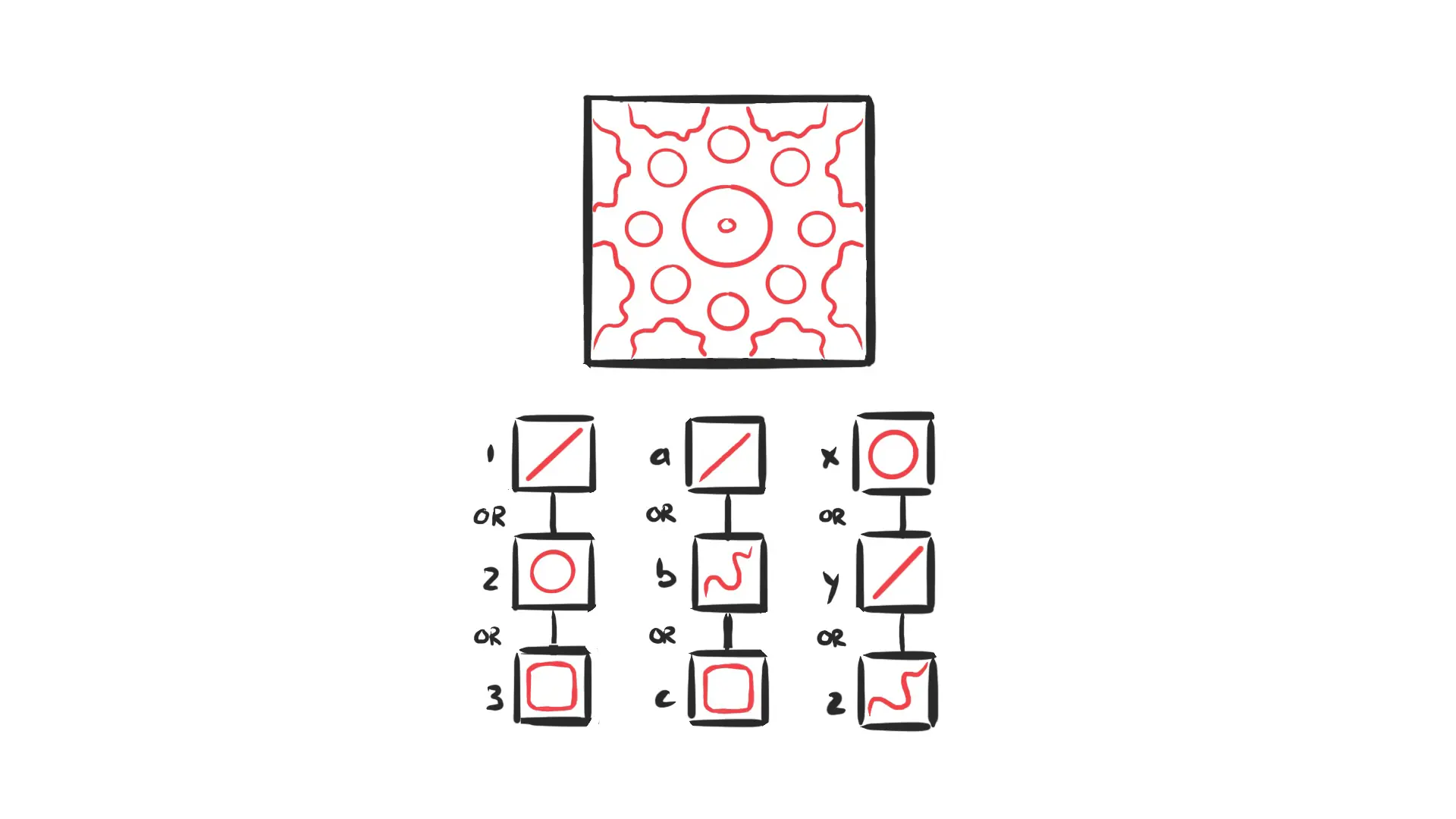
It tested well, and most players figured out the trick quickly. This paper prototype allowed me to convince game direction and validate the core puzzle loop immediately, without requiring a more elaborate digital prototype first. While the feature saw further iteration and challenges in various areas during development, the core puzzle never had to change.
Established a new workflow to improve feature implementation quality, find bugs and flaws early, help establish metrics and provide the level design team with reference through in-engine documentation, otherwise known as "Gameplay Blocks"
During this project, we had to navigate a production reality that had previously caused major stumbling blocks on Metro: Awakening. Scope and budget constraints meant that Level Design had to build content before the feature set was solid enough.
On Metro, this caused the project to suffer in quality. We had solid interactions, but without early cross-pollination with Level Design, features like levers, valves and fuseboxes were often placed in environments not built for them, boiling down to a single purpose: opening doors.
To improve our workflow on this new project, we introduced a new level of quality for the features; the “MVP“. This meant that the first iterations of a feature had to meet a baseline quality so that it was immediately usable by Level Design and clearly indicative of its final purpose. While this unblocked the content team initially, the MVP approach revealed critical flaws when applied to new and complex mechanics.
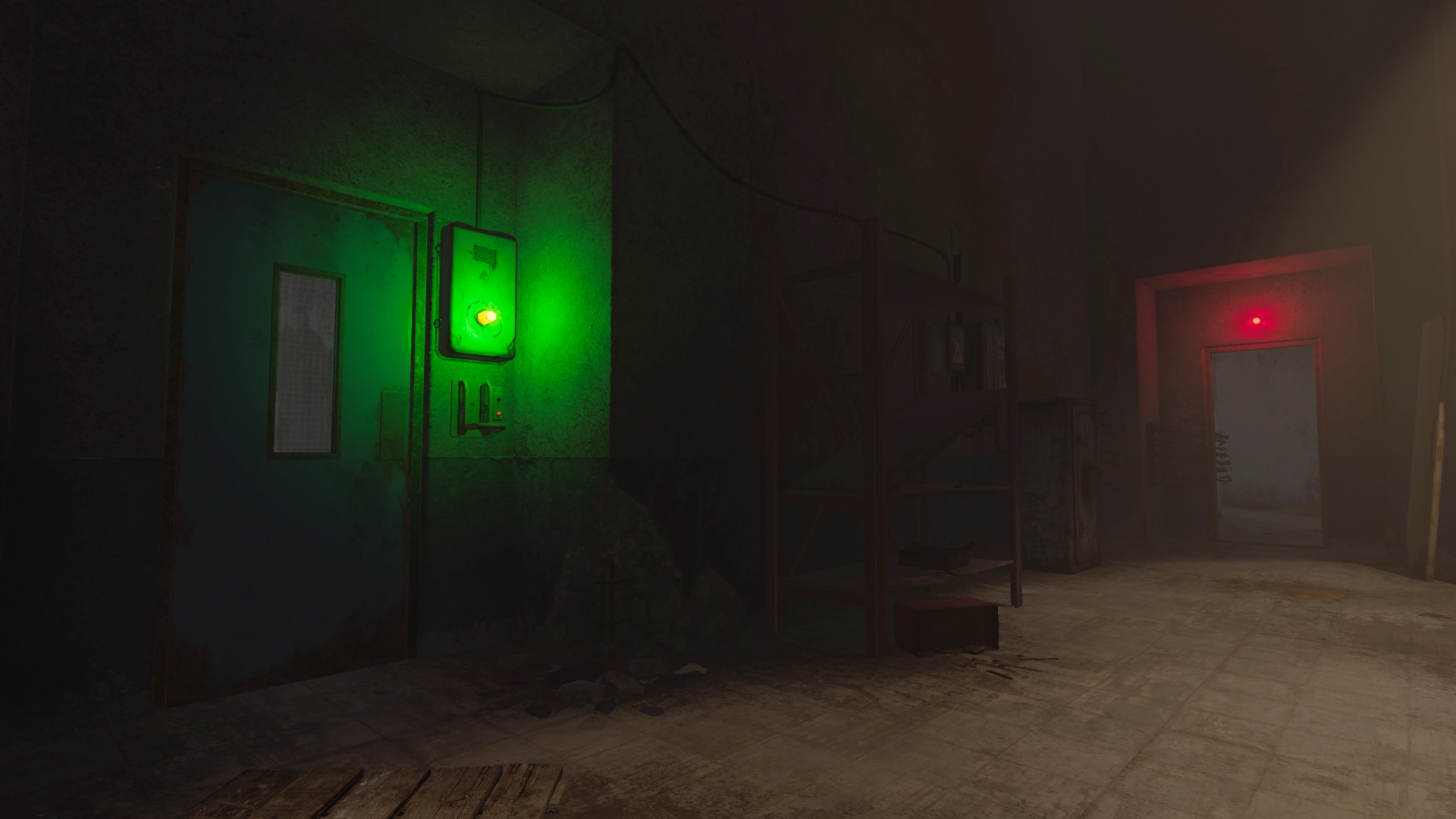
This became evident during the development of a specific puzzle concept. I finished the MVP implementation just before a month-long holiday, leaving it to be implemented by Level Design in my absence. Sadly, the only team member available to pick up further iteration was an intern who had joined weeks prior. While they showed promise, they didn’t have the strength to push back against conflicting wishes from Art and Game Direction.
Consequently, the puzzle was iterated on from the wrong perspective. Art challenges were resolved, but we failed to iterate on the design problems and lost the unique qualities that made the puzzle strong for VR. By the time I had returned, we had run out of time; releasing the concept “to the wild” too early had backfired. In retrospect, I should have pushed back firmly rather than accepting the compromised design, as it continued to be a challenging feature all the way up to the Vertical Slice.
To address these concerns, I formalized a new workflow once the feature team had grown under my leadership: Gameplay Blocks.
A Gameplay Block refers to the creation of functional documentation in software. A developer could launch a demo room that contained the feature and understand:
- How to use it
- How to ramp up difficulty
- How to combine it with other mechanics
- How to implement it within a level
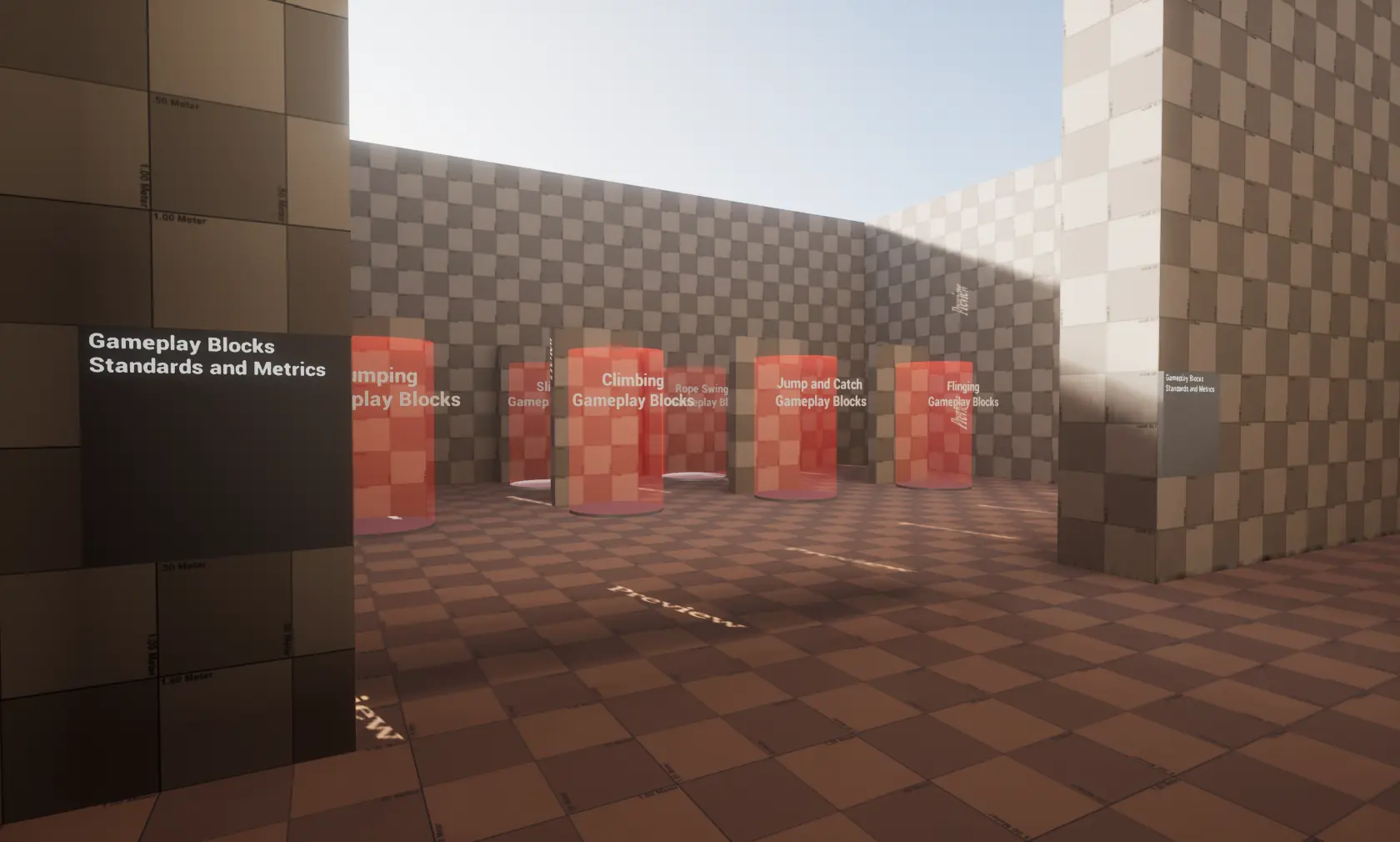
In-engine text would explain the intended player experience and how the overall gameplay vision was supported. For the feature team, creating gameplay blocks allowed us to push each feature to their limits quickly, exposing design flaws and bugs before the feature was implemented in levels. It also served as a testing ground to establish golden values.
While the project was suspended shortly after this workflow was introduced, preventing me from validating it long term, formalizing it did immediately improve how we evaluated features and helped bridge the gap between our disciplines.
Drove hands-on feature design for core gameplay, stepping away from strict tactile simulation to focus on implementing accessible, satisfying game feel and fun, and engineering a highly flexible player tool prototype robust enough to transition into production.
Alongside my management responsibilities and puzzle design, I maintained direct ownership over the creation of key player systems, most notably designing and implementing a bow that served as both a weapon and a tool.
This project shifted away from the tactile immersion that Metro focused on, prioritizing streamlined, accessible fun. For example, for the bow, this meant having arrows auto-nock as soon as the player grabbed the string, removing the clunky, repetitive friction of reaching over a virtual shoulder.
To ensure the weapon felt powerful for everyone, we employed tricks like artificially scaling the draw distance of the player and including simple aim assist. This allowed players to feel like they were making a full, satisfying draw motion without actually having to. This ensured shorter players could operate the weapon just as effectively as taller players.
The bow also served as driver for the rope mechanics, a tool intended to bridge three gameplay pillars: puzzles, combat and traversal. Players could remotely operate machinery by shooting an arrow into it, which magically spawned a rope in their hands. They could then pull it, connect to other mechanisms or use it to create ziplines.
My prototype implementation focused heavily on an extendable base system with a clear modular and scalable structure. Initial prototypes were extremely flexible, allowing players to create chains of mechanisms and even swing freely from any rope. While that level of freedom was pragmatically descoped due to production and level design concerns, building up the core system in this flexible way paid off.
When the implementation was handed over to the tech team, they were able to continue building directly on top of my Blueprint logic without having to do a full refactor.
Supervised the development of core VR locomotion, establishing systems for climbing, base locomotion, jumping, swimming, and platforming, including the creation of a fully functional full body avatar.
Guided AI feature design for enemy behaviors, such as a Hyena enemy. Directed and eventually went hands-on to develop the studio’s first AAA boss fight.
Bridged the feature design team and supporting disciplines to navigate conflicts and maintain the gameplay vision. Facilitated the epic review process, evaluated features against strict budgets, and ensured all critical deliverables met the quality bar for a Vertical Slice that was highly praised internally and externally.